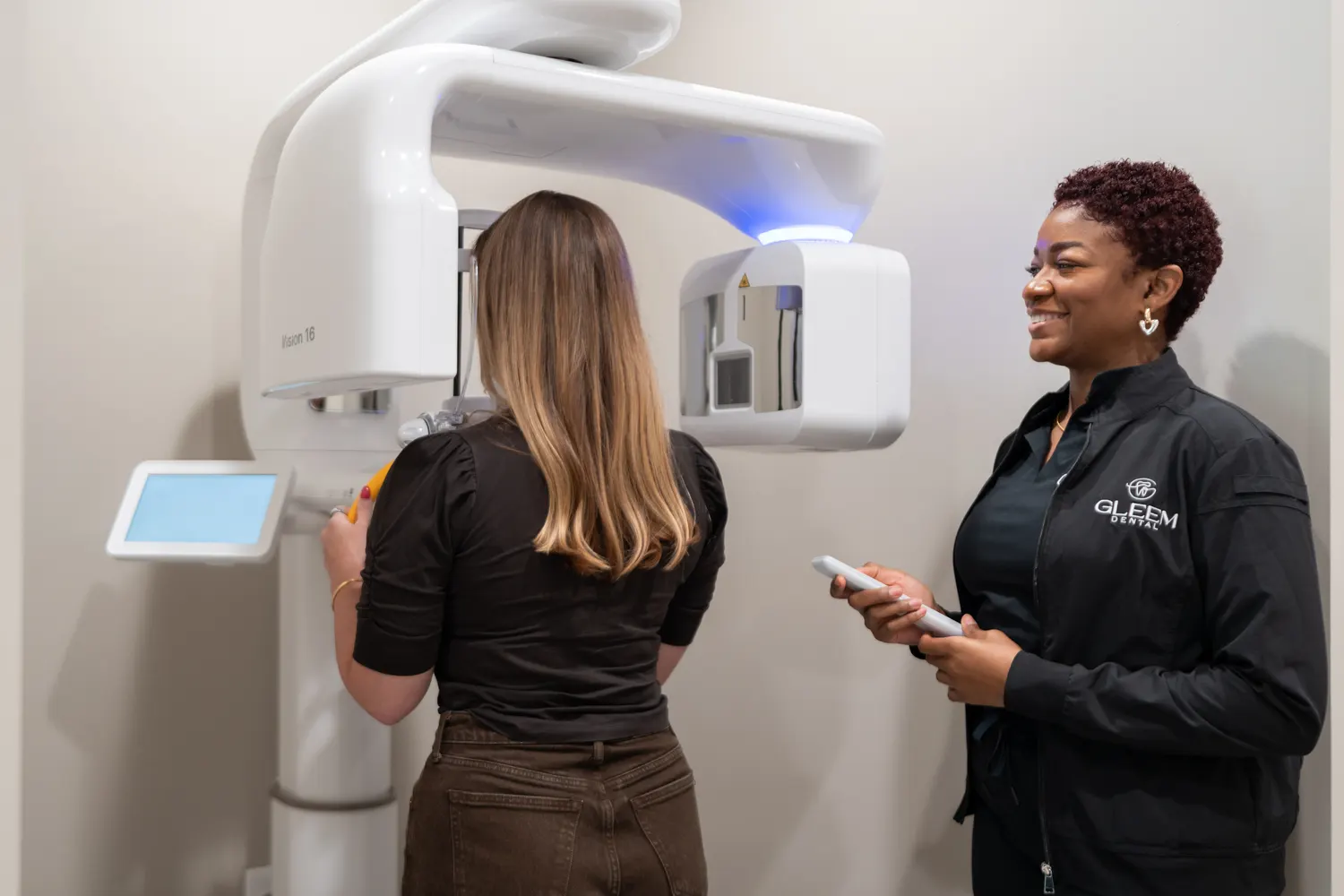
All-on-4 dental implants replace an entire upper or lower arch of missing, failing, or extracted teeth using just four strategically placed implants to support a full fixed bridge — and the best candidates are patients with significant tooth loss or multiple failing teeth who want a permanent, non-removable solution rather than traditional dentures. The "4" refers to implant positioning, not a limit on complexity: the procedure uses angled rear implants to anchor into denser jawbone, which is often what makes it possible even for patients who've been told they don't have enough bone for traditional implants. At Gleem Dental, Dr. Caylin Greene evaluates All-on-4 candidacy with 3D imaging that maps your actual bone density and structure, rather than ruling it out from a visual exam alone.
Here's an honest look at who's actually a good candidate, what the procedure involves, and what recovery realistically looks like.
Who Is Actually a Good Candidate for All-on-4?
All-on-4 is generally a strong option for patients who are dealing with:
- Multiple missing teeth in the same arch, whether from past extractions, injury, or long-term tooth loss
- Widespread tooth failure from advanced decay or gum disease, where several teeth per arch are beyond saving
- Full or partial denture wearers who are frustrated with slipping, discomfort, or the inability to eat certain foods confidently
- Patients with some bone loss who've been told traditional implants (which typically need more bone volume per tooth) aren't an option
- Patients who want a fixed, non-removable result rather than a denture that comes in and out
The clearest way to know if you're a candidate is a 3D scan, which shows bone density and structure in a way that a visual exam simply can't.
What If You've Been Told You Don't Have Enough Bone?
This is one of the more common reasons patients assume All-on-4 isn't an option for them — and one of the more common cases where it turns out to be. Because All-on-4 uses fewer implants, placed at an angle into the denser, more available bone toward the back of the jaw, it often requires less bone volume than placing a traditional implant under every missing tooth. Many patients who were told they'd need bone grafting for conventional implants are still viable candidates for All-on-4 without that additional step.
What Actually Happens During the All-on-4 Procedure?
The process typically unfolds in two phases:
- Implant placement — four implants are surgically placed into the jawbone, two positioned straight at the front and two angled toward the back, under local anesthesia or sedation
- Temporary fixed bridge — a provisional full-arch bridge is attached to the implants the same day in many cases, so you leave with functional, fixed teeth rather than a gap
- Healing period — over the following months, the implants fuse with the jawbone (osseointegration), which is what gives the final restoration its stability
- Final bridge placement — once healing is confirmed, the temporary bridge is replaced with a custom-fitted permanent one
Most patients function with a full set of fixed teeth from the day of surgery onward, even while the permanent bridge is still being finalized.
What Does Recovery Actually Look Like?
Recovery from All-on-4 surgery is more involved than a single implant, but still follows a fairly predictable path:
- The first few days typically involve swelling, some bruising, and soreness, managed with prescribed or over-the-counter pain medication
- A soft-food diet is necessary for several weeks while the surgical sites begin healing
- Most patients return to work and normal routines within a few days to a week, depending on the physical demands of their job
- Full osseointegration — the implants fully bonding with the jawbone — takes several months, even though the temporary bridge makes you functional almost immediately
- Follow-up appointments monitor healing and determine when you're ready for the final, permanent bridge
How Is All-on-4 Different From Traditional Dentures?
The biggest difference is stability. Traditional dentures rest on the gums and can shift, slip, or need adhesive, which affects both chewing confidence and speech. All-on-4 is anchored directly to the jawbone through the implants, so the bridge doesn't move — patients can bite and chew close to the way they could with natural teeth. It also eliminates the gradual bone loss that happens under traditional dentures over time, since the implants themselves stimulate the jawbone the way natural tooth roots do.
How Long Does an All-on-4 Restoration Actually Last?
With proper care — daily cleaning, regular dental checkups, and avoiding excessive force on the restoration — the implants themselves are designed to last decades, in many cases a patient's lifetime. The fixed bridge attached to them may eventually need replacement or adjustment due to normal wear, typically after many years of function, but the implants supporting it are built for long-term, permanent use.
The Bottom Line for New Orleans Patients
All-on-4 is often a good fit for patients with extensive tooth loss or failing teeth who want a fixed, permanent alternative to removable dentures — including many patients who assumed limited bone density ruled them out. The only reliable way to know is a 3D imaging-based evaluation, not a guess based on how much bone loss looks like on the surface.
Find Out If You're a Candidate for All-on-4 in New Orleans
Dr. Caylin Greene evaluates All-on-4 dental implants at Gleem Dental using 3D imaging to assess your bone structure and candidacy. For patients who need a broader evaluation of their bite and remaining teeth, full mouth reconstruction and implant-supported dentures may also be part of the conversation. Gleem Dental proudly serves patients throughout Lakeview, New Orleans, and the surrounding areas.
To find out if All-on-4 is right for you, call (504) 553-1393.